
the 119 women to enter the Academy in 1976, only 62 would continue on to graduation day in 1980 and of those only 2 were African American.

the 119 women to enter the Academy in 1976, only 62 would continue on to graduation day in 1980 and of those only 2 were African American.


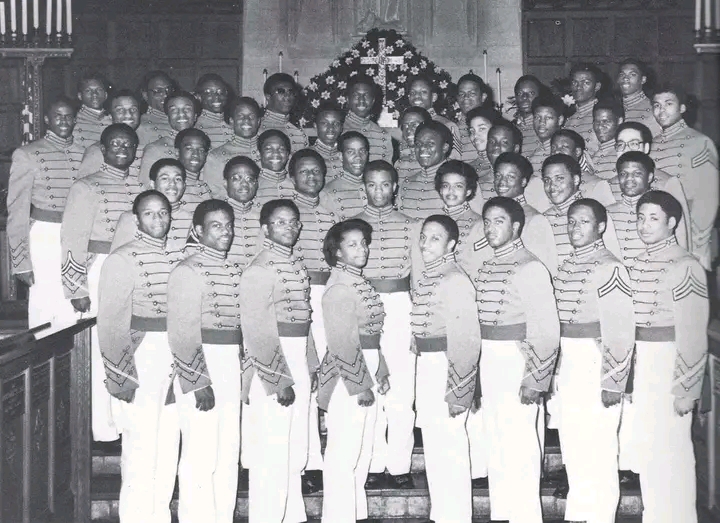

Priscilla Walker Locke and Joy Suzanne Dallas made history by becoming the first African American women to join the Long Gray Line. 

Locke from Detroit, Michigan was the first African American woman to graduate by order of merit.  She first enlisted in the United States Army in 1974 as a communications specialist. 

As a Private First Class she was encouraged by her commanding officer to apply to the Academy and was accepted to attend the United States Military Academy Preparatory School. 

After graduation she served in the Air Defense Artillery Corps until retiring in 1995 as a Major. In 2015, Locke watched as her daughter Sara also graduated from West Point and received assignment in the United States Army Military Police Corps.

Dallas from Fairborn, Ohio was an active member of the United States Military Academy Cadet Gospel Choir. After graduation she served in the Air Defense Artillery Corps until retiring from the Army as a Lieutenant Colonel.

Comments

Popular posts from this blog

A great story about a little bit of 'humanity' during a terrible war.

A great story about a little bit of 'humanity' during a terrible war.                                                                                      In April 1945, 2nd Lt. Peter During was a South African fighter pilot (N.7 Squadron) running missions over Italy when his Spitfire was shot down by German AA fire. He managed to crash land his plane behind enemy lines where he was immediately captured.   Whilst been escorted to a German Lufwaffe Prisoner of War (POW) camp (he was a pilot and thus his interrogation and imprisonment was the responsibility of the German airforce), he opened a conversation with his captors. He was quickly able to establish that they could already see the writing on the wall, that the war was at an end and Germany would lose it. ...

French woman accused of sleeping with Germans during the occupation has her head shaved by vindictive neighbors in village near Marseilles.

French woman accused of sleeping with Germans during the occupation has her head shaved by vindictive neighbors in village near Marseilles.  Antony Beevor wrote: "... In Paris, there were cases of prostitutes kicked to death for having accepted German soldiers as clients. (...) A large number of the victims were prostitutes who had simply plied their trade with Germans as well as Frenchmen, although in some areas it was accepted that their conduct was professional rather than political, others were silly teenagers who had associated with German soldiers out of bravado or boredom.  In a number of cases, female schoolteachers who, living alone, had German soldiers billeted on them, were falsely denounced for having been a "mattress for the boches. (...) Women accused of having had an abortion were also assumed to have consorted with Germans.  Many victims were young mothers, whose husbands were in German prisoner-of-war camps. During the war, they often had no means of supp...

THE TERRIBLE STORY OF THE BATTLE SCARS OF NORMANDY.

 THE TERRIBLE STORY OF THE BATTLE SCARS OF NORMANDY. On June 6, 1944, the Allied forces launched a massive invasion of Normandy, France, which marked a turning point in World War II. The invasion, codenamed "Operation Overlord," involved over 156,000 troops, and was the largest amphibious assault in history. The battle for Normandy beach was a bloody and brutal one, and the scars of that conflict still remain today. The beaches of Normandy, including Omaha, Utah, Juno, Gold, and Sword, were heavily fortified by the German forces, with bunkers, barbed wire, and mines littering the landscape. The Allied forces faced heavy resistance as they landed on the beaches, with many soldiers losing their lives in the initial assault. The fighting was intense and chaotic, with both sides suffering heavy casualties. Today, the scars of that battle are still visible on the beaches of Normandy. The bunkers and fortifications built by the Germans still stand, reminders of the fierce resistanc...